

Berlin, August 22nd, 2026 (The Berlin Spectator) – It’s back to school for Berlin’s children and adolescents. Students who enjoyed their summer in Adelaide, Khao Lak or Varadero have about 48 hours to return home and pack their school bags. Those who spent the past six weeks on their balcony or on Netflix can skip the returning home part.
According to Berlin’s Senate Administration of Education, the number of students is growing. In total, 404,910 of them will be taught at public and private schools this new school year. This means there is an increase of 1,200.
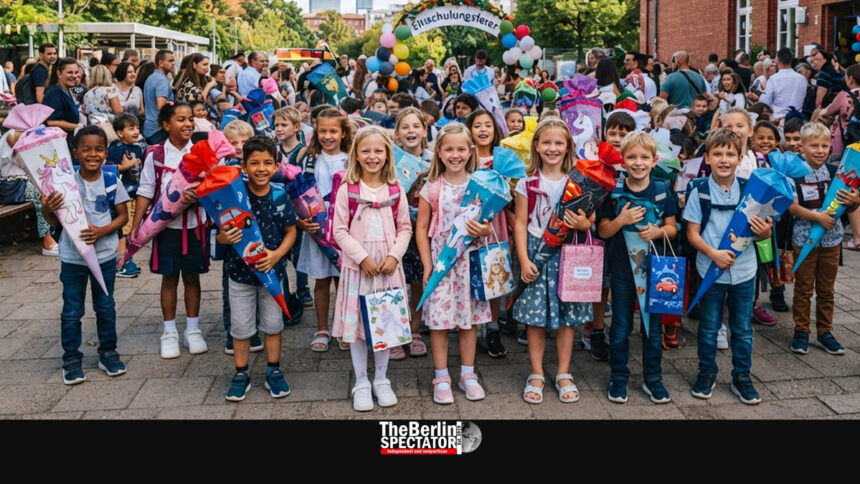
Berlin’s primary schools are expecting 35,550 new first graders, 276 less than last year. Those beginner students have an advantage: They can keep on playing in the mornings for another week. On Saturday, August 29th, they are supposed to take part in enrollment celebrations on their schoolyards. Learning the letters and numbers commences on Monday, August 31st.
“Welcome Classes”
For refugee, migrant or expat kids, Berlin offers “welcome classes”. For a few weeks, they study German and learn about cross-cultural differences before they join the German capital’s regular schools. The refugee home in Landsberger Allee located in the north of the city has its own welcome class. At this stage, 40 children are being taught there, according to the Senate Administration of Education.
Berlin has some 850 primary, secondary and high schools. Most of them are public. For this new school year, the city state managed to increase the number of spaces for young students by 8,000. These efforts include nine new school buildings that are being inaugurated right now. But there is still a school space deficit. Berlin has allocated 2.8 billion Euro (3.3 billion U.S. Dollars or 2.4 billion Pounds Sterling) until the end of 2027 to make even more room for students.
Does The Berlin Spectator have a newsletter? Sure. You can subscribe here.
So, we’ve covered the students and the school buildings. What’s missing? Oh, yes! We almost forgot the teachers. There are some 35,000 of them. The teacher deficit Berlin had was decreased to a harmless-sounding 209. Exactly 63 percent of all teachers in the city are official civil servants with all the advantages that come with this status, while 37 percent are employed the regular way. The number of prospective teachers who support their colleagues at Berlin’s schools increased by about 150 to 1,850. It is safe to say Berlin is prepared.
Peculiarities and Challenges
Germany’s federal system comes with a few peculiarities. One of them is the fact that the federal states can decide how to shape their education systems, which is why there are differences. In Berlin, primary school includes grades one to six, while it is one to four in most other states. This means that kids who move to the capital while they are fifth or sixth graders are forced to go back to primary school from secondary school.
One of the challenges Berlin has: At some schools, many students need German language support while others do not. The challenge is to improve the language knowledge of some while not slowing down the others.
With the new school year, Berlin’s Education Senator Katharina Günther-Wünsch intends to increase the education quality and results. One of her goals is to strengthen the linguistic and mathematical skills of Berlin’s students. “Good education requires clear goals, strong schools, and above all dedicated teachers who support and encourage our children and young people every day”, Günther-Wünsch stated on Friday.
“Reliable Conditions”
“That’s why we’re working on both fronts: raising the quality of education and creating reliable conditions for our schools and their staff. We’re creating new school places, recruiting and training staff, providing relief where it’s needed, and investing in modern infrastructure.” At the same time, she wanted to keep a consistent focus on the quality of teaching and support, the Senator said. “Our goal for the new school year is clear: to make Berlin’s schools better step by step, with good education for our children and young people and good working conditions for everyone who shapes school life every day.”
Her plans include improvements in the areas of early education, career orientation, and digitalization, which is an area Berlin appears to be rather weak in.