

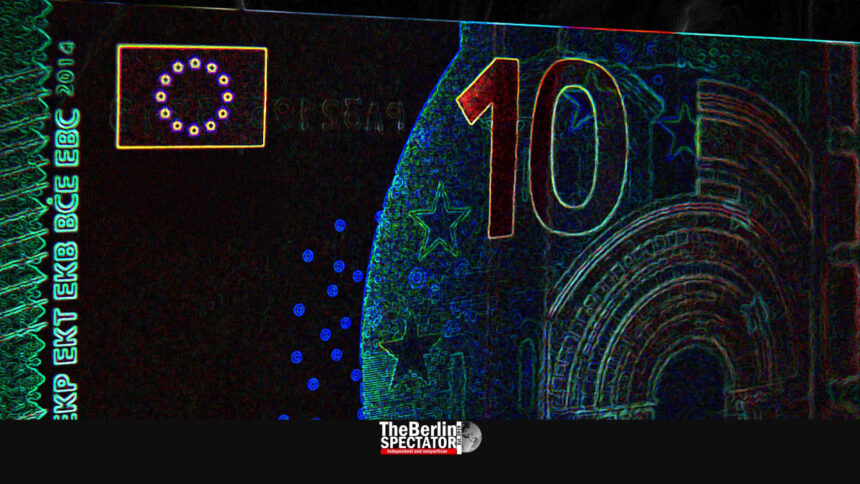
Berlin, August 25th, 2026 (The Berlin Spectator) – The European Central Bank has thrown open the doors on one of the most publicly visible projects in its history: choosing what the next generation of Euro banknotes will look like. The ECB unveiled ten shortlisted design proposals in Frankfurt and simultaneously launched an online survey inviting citizens across the Eurozone to weigh in. It is the first time ordinary people have had a direct say in shaping the currency’s appearance.
The banknotes currently in circulation date back to the Euro’s launch in 2002, and this would be their first comprehensive overhaul. The ECB frames the project around several practical goals rather than aesthetics alone: strengthening security features so notes are easier to verify and harder to counterfeit, improving accessibility for blind and partially sighted users, increasing durability, and reducing the environmental footprint of producing and circulating cash. At the same time, the ECB wants the new series to express a shared European identity.
ECB President Christine Lagarde described banknotes as more than a means of payment, calling them one of the most tangible everyday expressions of Europe.
25 Out Of 1,200 Applications
The process began with a EU-wide design contest open to graphic designers residing in the Union. More than 1,200 applications came in, and 25 designers were eventually invited to develop full proposals. Before that, the ECB’s Governing Council had already settled on two overarching themes following earlier rounds of expert and public consultation: “European culture,” built around shared cultural spaces and notable Europeans, and “Rivers and birds,” built around the resilience and diversity of the continent’s natural landscapes.
Working within those themes and a set of ECB guidelines on format, security placeholders and general composition, participating designers were free to interpret the motifs creatively. The ECB stresses that the resulting artwork reflects each designer’s own vision and does not represent a commitment to any specific final element.
An independent jury of 21 specialists spanning graphic design, communications, history and neuroscience narrowed the submissions down to ten finalists, five for each theme.
Curie and Cervantes
Under “European culture,” five proposals put historical figures on the front of the notes: the soprano Maria Callas on the €5, composer Ludwig van Beethoven on the €10, physicist Marie Curie on the €20, writer Miguel de Cervantes on the €50, artist and inventor Leonardo da Vinci on the €100, and the Austrian pacifist and Nobel laureate Bertha von Suttner on the €200. Their reverse sides depict cultural and leisure scenes such as a choir or a library. One submission from the Spanish studios Rubio & del Amo and Cruz mas Cruz even proposes breaking with convention by turning the notes vertical rather than horizontal.
The “Rivers and birds” proposals instead pair European bird species — among them the kingfisher, the European bee-eater, the white stork, the wallcreeper, the avocet and the northern gannet — with river landscapes on the front, while the reverse sides feature one of the European Union’s main institutions, from the European Parliament to the Court of Justice.
The Public’s Turn
Anyone can browse the ten proposals and take part in the ECB’s online survey, open until September 21st, 2026, to say which designs they favor. A separate but identical survey is being run in parallel by an independent research firm among a representative sample of Eurozone residents, so the results can be weighed both as an open public consultation and as a statistically representative poll. By mid-August, the ECB reported that the public survey had already drawn around six million responses, roughly a million a day since launch.
Survey feedback will not decide the outcome on its own. The Governing Council says it will base its final choice on a combination of inputs: the design jury’s conclusions, a technical assessment covering functionality, production and security, and the results of both surveys. A final decision is expected around the end of 2026, after which the winning concept will go through further development, testing and the addition of enhanced security and accessibility features before entering production. The ECB has made clear that the new notes will not appear in wallets any time soon. They are expected to enter circulation gradually, alongside the current series, “in the coming years.”
The ECB survey on the new Euro notes design can be reached here.