

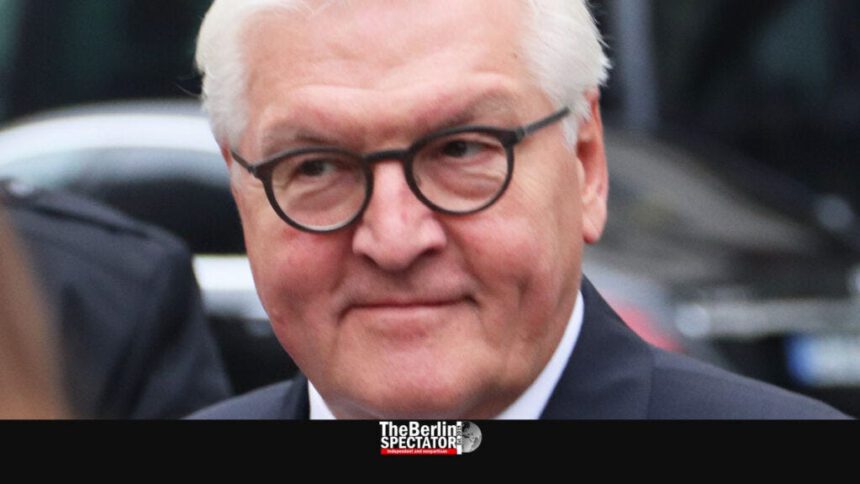
Berlin, August 26th, 2026 (The Berlin Spectator) – German President Frank-Walter Steinmeier came out firmly in favor of immigration to Germany, cautioning against treating naturalized citizens as lesser members of society. “There is no such thing as first- or second-class citizens,” he said in Berlin. “The ‘German people,’ in the sense our constitution means it, includes Germans who have joined us along the way.”
The country, he added, “belongs to everyone who lives here lawfully, who shapes it every day, who grows up and grows old here, who learns and works here, who hopes and argues here.”
Steinmeier stated that Germany’s constitution knows no ethnic community bound by common blood, and grants no special citizenship privileges to so-called “Biodeutsche” – native-born Germans. Neither the origin of one’s grandparents nor the blood in one’s veins is what makes someone German, he said in Berlin, according to German-language media.
A Warning Against Undermining the Constitution
“What matters is citizenship, whether acquired by birth or through naturalization. It’s the language we share. It’s the wish to live together peacefully, in freedom. It’s the constitution we all stand on,” Steinmeier said.
The President warned against ranking degrees of “Germanness”: “Whoever wants to sort and grade what it means to be German, whoever starts handing out citizenship rights based on group membership rather than to the individual, is attacking our constitution and placing themselves outside our democratic order.”
Steinmeier did not mention the extremist right-wing AfD by name, but his remarks were widely understood as a rebuke of the party’s rejection of immigration and its calls for measures such as sending all Syrian refugees back to Syria.
Overwhelmed by Immigration
“Those who are allowed to stay should be able to belong. Everyone needs access to schools, housing, and medical care,” Steinmeier said. “And those who have to leave, must actually leave.”
Steinmeier urged policymakers to take seriously the concerns of citizens who feel overwhelmed by immigration. “When people have lost trust that coexistence can work, that’s where politics has to step in, by tackling the obvious problems quickly and decisively, and offering solutions.”
Germany needed immigration to function, he said, pointing to hospitals, nursing homes and care facilities, and increasingly, large parts of the private economy as well. He acknowledged that immigration demands something of long-established residents and municipalities, but said it also gives something back, for instance when local companies find good employees. “It benefits a city when young people help counter an aging population, when children are out playing in schoolyards,” Steinmeier said.