


Berlin, August 28th, 2026 (The Berlin Spectator) – The disease Mpox is increasingly being transmitted in Berlin through sex between men and women. Berlin’s State Office for Health and Social Affairs (Lageso) has received several reports of cases linked to sex-positive events for heterosexual and queer people, according to the office’s latest weekly report.
In August, two women were reported to have contracted Mpox. During the same period, a man also became infected. He said he may have caught the virus through sex with a woman. All three are believed to have been infected during anonymous sexual encounters, either in clubs or at home.
More Cases Than in Previous Years
So far this year, Lageso has recorded four Mpox infections among women. The disease has traditionally affected mostly men who have sex with men and frequently change partners.
The total number of Mpox cases reported in Berlin this year stands at 156. That is more than in the same period last year (144) and considerably more than in all of 2024 (38) or 2023 (13).
Across Germany, the Robert Koch Institute (RKI) has recorded 375 Mpox cases so far this year, as of August 27th. Ninety-eight percent of those infected were men. Almost all of the men whose infection route is known became infected through sex with other men. Jansen said no nationwide trend resembling the one Lageso described for Berlin has been observed so far, adding that it remains to be seen how the situation develops.
“It Concerns Us Greatly”
Lageso infectious disease epidemiologist Claudia Ruscher said the fact that Mpox is spreading into a group that had previously seemed unaffected, and is therefore less vaccinated and less informed, is deeply concerning.
Four cases among women may not sound like much on its own, she said, but a new dynamic appears to be forming, since the infections occurred within a short span of time. In previous years, either no women or just one per year became infected. Only during the large 2022 outbreak did the number of female cases reach four as well, though the overall case count during that outbreak was roughly ten times higher than it is now.
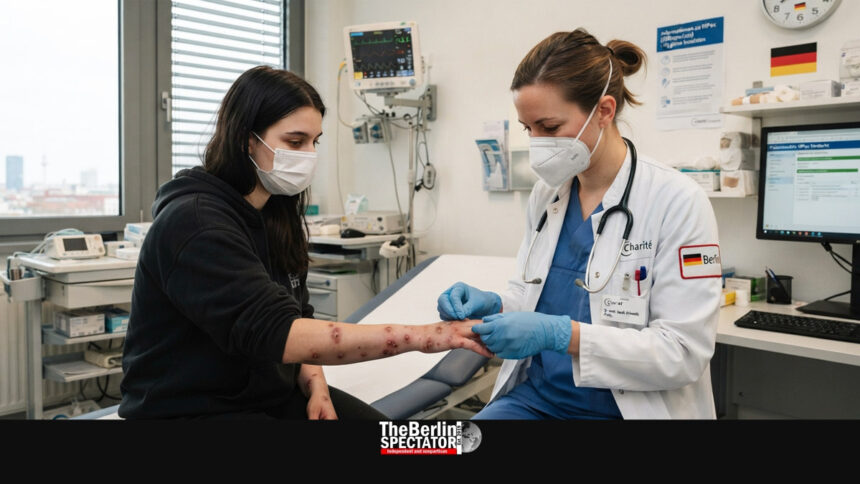
What are the risks? People who are unvaccinated and become infected with Mpox for the first time tend to experience a more severe course of illness, Ruscher explained. They are more likely to develop feverish symptoms and skin lesions across the entire body. These are not just small blisters, she said, but itchy, sometimes pus-filled pustules that can be extremely painful.
Close Physical Contact
Mpox is a viral disease transmitted through close physical contact, above all during sex. The main risk of infection comes from contact with the skin changes typical of the disease, such as blisters or scabs, which can appear anywhere on the body. Condoms therefore do not provide sufficient protection. Transmission through droplets, meaning saliva, is also possible. A vaccine against Mpox exists.
In 2022, the disease spread especially widely in Germany. At the time, it mainly affected men who have sex with men and frequently change sexual partners. A targeted vaccination campaign followed for this group, and the willingness to get vaccinated was high.
Razor Bumps? Insect Bite? Herpes?
Other groups often are not even aware Mpox exists, Ruscher said. When they become infected and pustules appear, they usually do not connect the symptoms to Mpox at all. Instead, she said, they assume they have razor bumps, an insect bite, or herpes, and often do not see a doctor right away. One patient reportedly visited four different doctors before receiving the correct diagnosis.
How does Ruscher expect the situation to develop? Further infections among women should be expected, she said, though it is difficult to predict the scale.
Germany’s Standing Committee on Vaccination (STIKO) recommends the Mpox vaccine for men, transgender people, and non-binary people who have sex with men and frequently change partners, as well as for sex workers and people who have contact with infected individuals. According to Jansen, the vaccine is highly effective and well tolerated. Those who become infected despite vaccination generally experience a much milder course of illness.