
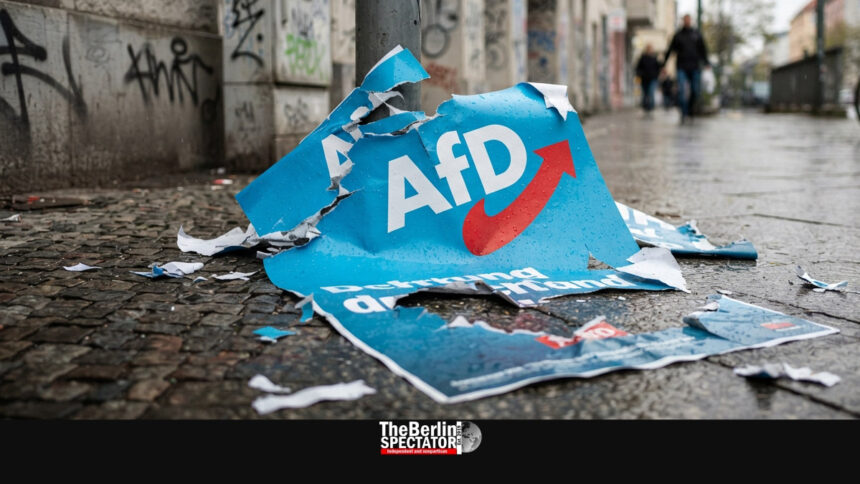
Berlin, August 28th, 2026 (The Berlin Spectator) – A new analysis published by the American Jewish Committee (AJC) argues that antisemitism is not a marginal problem within the extremist right-wing AfD but a structural feature of the party’s ideology, its rhetoric and its voter base.
The report, authored by political scientist Lars Rensmann and published as part of a broader study on political antisemitism in postfactual democracies, examines the AfD’s language, campaigns, media environment and electorate. Its conclusion: Even where the party avoids explicit antisemitic slurs, its ideology is saturated with antisemitic tropes, coded language and conspiracy narratives.
A Party Built on “Us vs. Them”
According to Rensmann, the AfD’s worldview rests on a fundamental split between a supposedly homogeneous “true” German people and a hostile, corrupt elite allegedly working with outside forces. This friend-or-foe framing, the report argues, echoes patterns historically used to cast Jews as an internal-external threat to the nation.
The study traces this back to the party’s platforms since 2017 and to statements by senior AfD figures. Thuringia’s AfD chairman Björn Höcke, for instance, has written of preventing what he calls a “Volkstod”, or death of the people, through mass “remigration” – a term the report notes originated with the far-right “Identitarian Movement” and became central to the AfD’s 2025 election campaign.
Rensmann also points to the party’s proximity to Höcke’s now formally dissolved “Der Flügel” faction, and quotes former honorary AfD chairman Alexander Gauland’s 2019 remark that Höcke “is the center of the party.”
Soros, “Globalists” and the “Lying Press”
A central chapter of the report focuses on what Rensmann calls the AfD’s “modernized” antisemitism – hostility that rarely names Jews directly but activates classic antisemitic imagery through other targets. Chief among them, he writes, is the investor George Soros, whom AfD figures repeatedly cast as a “puppet master” orchestrating migration and cultural change in Europe.
The report also links the AfD’s frequent use of the term “Lügenpresse”, or lying press, to older antisemitic stereotypes about Jewish control of the media, noting the phrase’s roots in Nazi-era propaganda.
Downplaying the Holocaust
The report describes the AfD’s approach to Holocaust remembrance as a second major vector of antisemitism. It cites Gauland’s description of the Nazi era as “just a bird’s dropping” in German history, and Höcke’s 2017 call for a “180-degree turn” in how Germany remembers its past.
Rensmann argues that this narrative shifts the focus of national memory toward German suffering while sidelining Jewish victims – an approach he terms “secondary antisemitism” rooted in the rejection of historical guilt.
Direct Attacks on Jewish Public Figures
The report also documents campaigns by AfD accounts and members against individual Jewish figures, including anti-racism activist Anetta Kahane and journalist Michel Friedman. It describes an antisemitic caricature of Kahane, shared by an AfD Bundestag office, that drew on imagery historically used in Nazi propaganda.
Despite occasional pro-Israel statements, the AJC report finds the AfD’s declared “solidarity” with the Jewish state largely instrumental, tied mainly to the party’s anti-migration and anti-Islam messaging rather than genuine support. Rensmann notes that after October 7th, senior AfD figures offered only tepid or delayed condemnation of the Hamas attack.
The report cites several surveys suggesting antisemitic attitudes are notably more common among AfD voters than the wider electorate. In the 2024 Leipzig Authoritarianism Study, more than half of AfD voters agreed with statements minimizing Germany’s historical guilt, and the party’s supporters showed the highest agreement of any group surveyed with several distinct forms of antisemitism.
Rensmann concludes that antisemitism in the AfD should not be dismissed as the work of a few fringe figures. Rather, he writes, it is “closely interwoven” with the party’s broader far-right and conspiracist worldview, expressed through its platform, its leadership’s public statements and its online campaigns alike.
The entire AJC report can be accessed here.