

Berlin, July 27th, 2026 (The Berlin Spectator) – The man suspected of carrying out Saturday’s presumed Islamist-motivated attack near Christopher Street Day (CSD) was shot and killed by police on Sunday evening, bringing an abrupt end to the manhunt even as questions mount over how he came to be free in the first place.
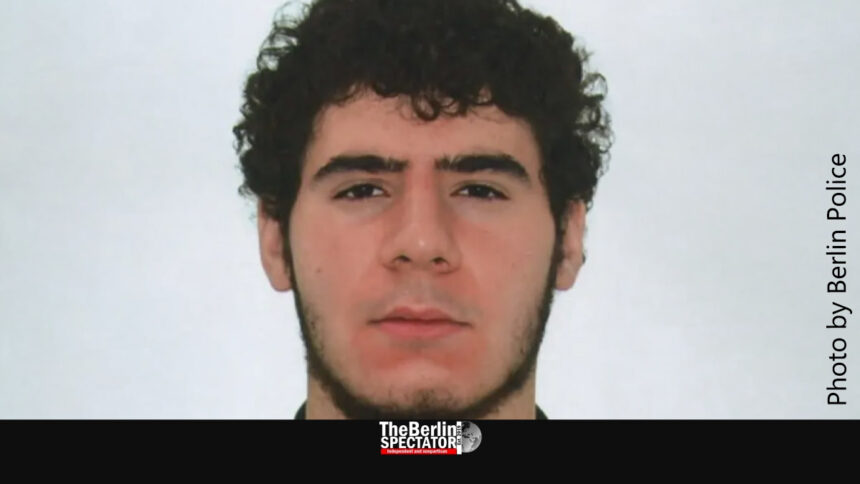
Berlin police said the 21-year-old suspect, identified as Abdul B., was tracked down at an allotment garden site in the Spandau district. According to police, he charged at officers with a bladed weapon, prompting Berlin’s SEK tactical unit to open fire. Despite immediate resuscitation efforts by the fire department, he died at the scene.
The Federal Prosecutor General’s Office — Germany’s highest prosecuting authority — has now taken over the investigation into the attack.
One Dead, 29 Injured
CSD festivities in Berlin were called off Saturday evening after a car was driven into the crowd near the event, killing one woman and injuring 29 others. Police said by Sunday afternoon none remained in life-threatening condition. The driver then allegedly attacked bystanders with what Interior Minister Alexander Dobrindt (CSU) described as a machete-type weapon before fleeing the scene. Investigators have concluded the attack was Islamist-motivated terrorism.
Authorities say Abdul B. was born and raised in Berlin and holds German citizenship. He has Lebanese roots, and his mother was naturalized in Germany in 2002. According to the Berlin Attorney General’s Office, he made repeated attempts last year to join the Islamic State (IS) militia abroad, and was detained in Lebanon in July 2025, where he served three months in custody before returning to Germany on November 17th and being arrested again on arrival at BER Airport.
He then spent months in German pretrial detention before a juvenile panel at the Tiergarten District Court convicted him in May 2026 — chiefly for preparing a serious act of violence endangering the state — and sentenced him to one year and ten months. The court lifted his existing arrest warrant at the time, reasoning that pretrial detention exists to secure proceedings rather than to serve as punishment in advance. That conviction was never finalized, as prosecutors had appealed for a longer, non-suspendable sentence and the reinstatement of his detention. During the trial, he had reportedly been largely cooperative and claimed to have distanced himself from IS.
Earlier this month, investigators searched his apartment in Berlin-Schöneberg over a preliminary weapons-law suspicion, though only a toy gun was found. He had reportedly been due to begin a deradicalization course this past Monday.
“Controlled” and “Friendly”
Thomas Mücke of the Violence Prevention Network, a German nonprofit that works with people drawn to extremist ideologies, said the social workers who had contact with Abdul B. found him composed and courteous.
Governing Mayor Kai Wegner (CDU) welcomed the speed of the manhunt on RBB radio, calling it a major success that police identified and located the suspect within 24 hours. At the same time, he voiced bewilderment over how the justice system had previously handled the case, noting the suspended sentence handed down under juvenile law. While stressing he wouldn’t second-guess judicial independence, Wegner said “words fail me here.”
Dobrindt, speaking to the ARD, acknowledged the suspect’s extensive criminal record, his sympathies for terrorism, and the suspended sentence being appealed by prosecutors. He said officials are now looking closely at how someone officially flagged as a security risk could receive a suspended sentence at all. In a separate interview with RTL, he called the leniency shown given the level of threat involved simply hard to understand.
Calls for Legal Reform
Terrorism researcher Peter Neumann of King’s College London argued German counterterrorism law is too lenient by European standards, telling ZDF TV that Germany’s juvenile justice framework — under which the suspect was sentenced — prioritizes rehabilitation in ways that can sideline public safety. He added that deradicalization programs can work when properly applied, but said that clearly wasn’t the case here.
Johannes Winkel, head of the CDU’s youth wing, the Junge Union, called for tougher legislation, telling “Stern” magazine that politics cannot simply move on and must overhaul the legal framework in response to the case — including, he said, removing the option to sentence security risks under juvenile law.
Chancellor Friedrich Merz (CDU) joined Sunday’s memorial service at Berlin’s St. Mary’s Church alongside Justice Minister Stefanie Hubig (SPD) and Education Minister Karin Prien (CDU), later visiting the attack site in the Tiergarten to lay white flowers alongside Dobrindt and Berlin’s Interior Senator Iris Spranger (SPD). Speaking beforehand, Merz repeated his message that the CSD community should not be intimidated, insisting extremists have no place in society and declaring, “We are more, we are stronger.”
At a separate event Sunday evening in Paderborn, Merz linked the attack to broader social attitudes, saying violence doesn’t start with an attack itself but with intolerance, exclusion and casual discrimination.
Wegner has defended the CSD safety measures as strong, noting the parade route itself was never breached. Dobrindt nonetheless urged organizers of major public events to reassess their security planning. Terrorism expert Felix Neumann of the Konrad Adenauer Foundation cautioned that attacks like this one are, realistically, nearly impossible to rule out entirely, however many precautions are taken.