

Naples, October 12th, 2022 (The Berlin Spectator) – “Use winter tires from ‘O’ to ‘O’.” That’s what the Germans say. The first “O” stands for October, and the second one for “Ostern”, the German word for Easter. This does not really work in English.
Let’s start from the beginning: Germany is located in the northern part of Central Europe, meaning that it does snow, at least as long as global warming does not turn this region into a beach resort with palm trees. From October to March (or April), low to freezing temperatures as well as snow and ice have to be expected, at least temporarily.
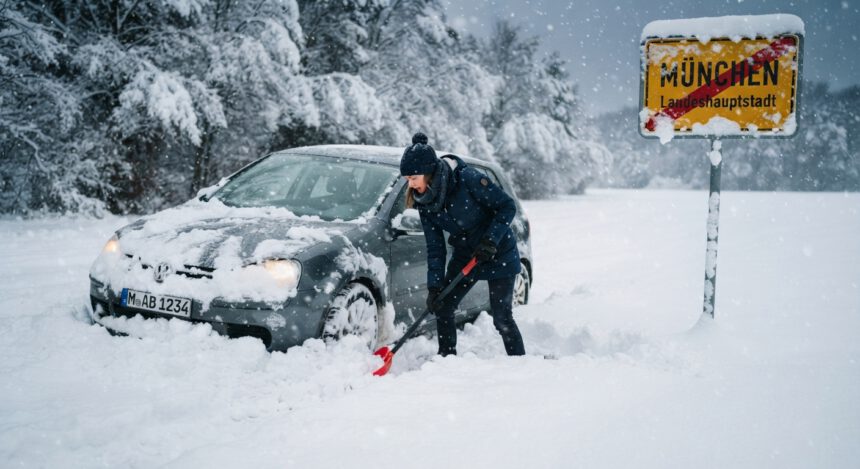
Adhering to the existing winter tire rules is essential. First of all, there is something called a “situational obligation” to use winter tires (yes, it’s obviously “tyres” in British English). If it is warm around Christmas, nobody will be fined if he or she uses summer tires. But when roads are frozen in October, or at any other time, they will.
The fine can be anywhere from 60 to 120 Euro, depending on whether the driver endangered others by not using winter tires. There is another issue: In case of an accident with summer tires on snowy or frozen roads or streets, the insurance will probably not pay, or it might cover part of the damage only.
More Grip
Whoever drives in wintry conditions needs to make sure his or her winter tire tread is at least 1.6 millimeters (0.06 inches) deep, according to the German law. At the same time, the General German Automobile Association (ADAC) recommends 4 millimeters (0.16 inches). That way, the tires have a lot more grip.
It is easy to establish whether the tread is good enough, with a 2 Euro coin. If the silver edge of that coin disappears in the tread, everything is fine. If it does not, new winter tires should be purchased. By the way: Winter tires do not only have a deeper tread, but they are made of a different composition of materials, to make sure they survive freezing temperatures.
Decades ago, winter tires made regular passenger cars sound like Soviet tanks, and they increased gasoline consumption to the level of those same vehicles. According to the ADAC, those times are over. Differences between summer and winter tires, in this regard, are hardly measurable.
By the way: Only tires with the three-peak mountain snowflake symbol count as winter tires. The old M+S-only tires lost their legal status for this purpose after September 30, 2024.
The summary:
- “Situational obligation”: Winter tires are required in freezing temperatures and/or wintry conditions.
- German law requires a tread of at least 1.6 millimeters. According to the ADAC, they should have a 4mm tread (0.16 inches).
- Winter tires create the grip needed in winter.
- Car insurers might not pay for any damage if an accident occurs in wintry conditions while summer tires were installed.
By the way: There are all-weather tires that can be used all year long. They are usually good enough for large cities in northern Germany. Berlin is not Oslo, and Hamburg is not Winnipeg. It is a different story in southern Bavaria and other mountainous regions. There, all-weather tires might not suffice.